How Teslin Cards, Barcode Cards And Key Tags Are Made.
Factor that makes one item (card, key tag or combination card with key tag) better than another.
-
- First and most important is the core stock. The finished product is only as good as the bond between the core stock and the lamination film. Using a paper product as a core stock, moisture will wick into the edges, and the product will separate. Using synthetic paper will solve your moisture problem, but just because a core stock is synthetic does not mean it will bond strong enough to the lamination film to make the product last. Teslin is the brand name of synthetic material that bonds up to 10 times stronger than other synthetic materials. Teslin is a synthetic material, but it does NOT make it Teslin because it is called synthetic. We are using Teslin and only Teslin as our core stock.
- Lamination films are not all the same. As noted below, a ten-mill film can be constructed in different ways. Polyester is part of the product (card) that protects the core stock. You need enough polyester to protect the core stock and adhesive to penetrate the core stock. Our ten mil film is constructed of 4 mil polyester and six mil adhesive, producing the correct balance. We give you twice the protection as manufactured using two milliliters of polyester and eight milliliters of adhesive. All lamination film has orientation or curl. Our 4/6 lamination is mapped and matched to eliminate the curl, make the card flat, and make the barcode read better. As part of our standard construction, we put a matte finish on the back of the card to reduce light reflection on the barcode, making the barcode read the first time. The matte finish also serves as a signature area.
- Bonding process: In the lamination stage or bonding process, everything comes together to make the final product. Our inks are formulated to be printed on Teslin and bond to hot melt lamination. We laminate at speeds that allow the adhesive to melt and penetrate the Teslin to form a strong physical and chemical bond.
- First and most important is the core stock. The finished product is only as good as the bond between the core stock and the lamination film. Using a paper product as a core stock, moisture will wick into the edges, and the product will separate. Using synthetic paper will solve your moisture problem, but just because a core stock is synthetic does not mean it will bond strong enough to the lamination film to make the product last. Teslin is the brand name of synthetic material that bonds up to 10 times stronger than other synthetic materials. Teslin is a synthetic material, but it does NOT make it Teslin because it is called synthetic. We are using Teslin and only Teslin as our core stock.
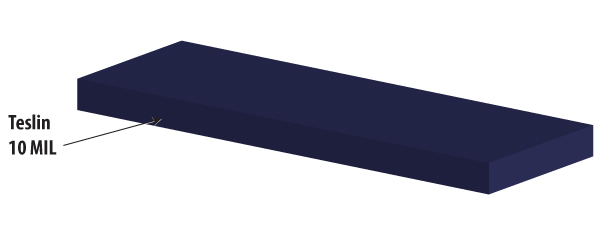
Core Stock is ten mil Teslin.
Teslin substrate is waterproof, resists abrasion and tearing, and stands up to a wide range of chemicals. It is water, tear, and abrasion resistant.
Teslin substrate forms adhesive bonds as much as 10 times stronger than other substrates—requiring no edge seals to produce durable, secure products.
Ten mil Teslin is the core stock we use on all our products.
Hot Melt Lamination
Hot melt lamination film is created by adding adhesive to the polyester film.
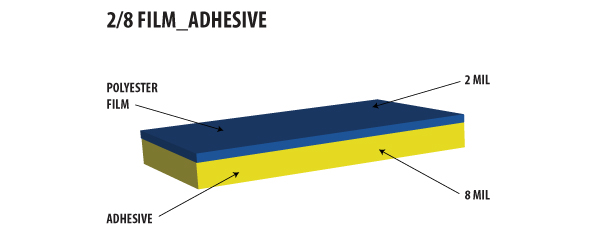
Hot melt lamination is expressed in the total thickness of the polyester and adhesive. The most common constructions of 10 mil film are listed below.
Two mils polyester -represented by blue, and eight mils adhesive- represented by yellow, commonly called 2/8.
Four mils polyester -represented by blue and six mil adhesive-represented by yellow, commonly called 4/6.
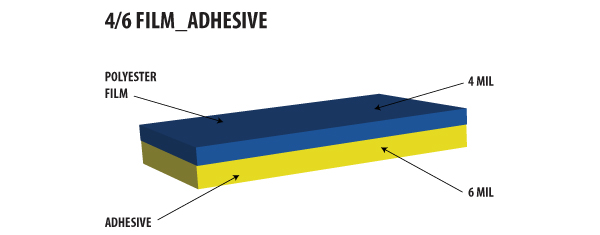
As you can see, we have a ten million thick film in both examples, but the 4/6 film has twice the polyester, which is part of the card that protects the printing and barcode. We use 4/6 film mapped and matched to lay flat, which is twice as thick.
Production of Teslin cards.
The Teslin core stock is printed on the front and back with the desired copy and barcode. Each sheet will contain multiple copies of the finished product.
The next step is to bond the Teslin core stock to the hot melt lamination.
The lamination is in a roll form and will have one roll of lamination for the front and one for the back of the card. The printed Teslin sheet is inserted between the two rolls of lamination.
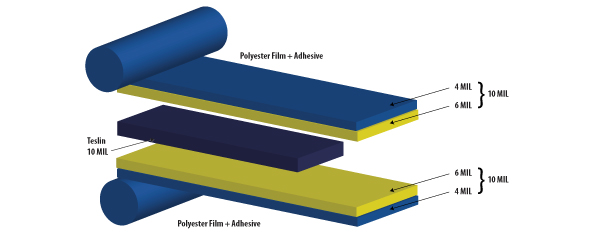
The heat turns the solid hot melt adhesive to a liquid, and the pressure forces the adhesive into the Teslin core stock, forming a physical and chemical bond. The strength of the bond is determined by materials, heat, pressure, and time at which the materials are under heat and pressure.
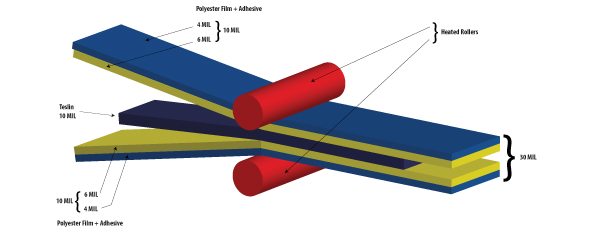
Once the film and Teslin have bonded, they are cooled and cut into sheets.
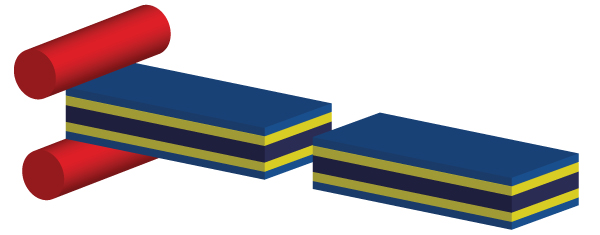
Next, the laminated sheets are inserted into a die cutter that cuts the sheet into individual items. The items can be cards, key tags, cards with one key tag, or any item desired. It is all determined by the die cut.


